

Coffee Beans Sowing Seeds Of Happiness: Vuong Thanh Cong Organic Coffee
Vuong Thanh Cong Production and Trading Co., Ltd. (Vuong Thanh Cong Organic Coffee – VTC) is among Vietnam’s pioneering enterprises committed to organic coffee, green economy principles, and circular economy practices. The company has been at the forefront of developing an integrated organic coffee model that harmoniously combines environmental restoration, community empowerment, and responsible value chain development—aimed at improving farmers’ livelihoods while elevating the global standing of Vietnamese coffee.
Rather than pursuing output volume alone, VTC positions coffee as a vehicle for social well-being, corporate responsibility, and long-term sustainable development.
From green coffee beans, roasted coffee, and freeze-dried instant coffee to innovative creations such as coffee flower tea, cascara tea, coffee wine, and coffee flower beer, VTC demonstrates that coffee is far more than an agricultural commodity. It is a cultural medium and a form of knowledge-based economy—one that tells stories of land stewardship, human dignity, and shared prosperity.

Context and Challenges
Vietnam is the world’s second-largest coffee exporter; however, the industry has long been facing a range of structural and persistent challenges. These include soil degradation caused by intensive chemical farming, rising input costs accompanied by declining farmer health, the marginalization of smallholder farmers within the value chain, and increasing global pressure for sustainability, traceability, and ethical production.
In Đắk Lắk, many coffee growers remain trapped in a vicious cycle of high production costs, environmental degradation, and unstable incomes, while Vietnamese coffee continues to be largely perceived in international markets as a low-value raw commodity.
VTC recognized that without a fundamental shift in production models, neither farmers’ livelihoods nor the coffee ecosystem itself could be sustained in the long term.
Amid climate change, volatility in global markets, and growing tariff pressures, the limitations of conventional coffee production have become increasingly evident. VTC deliberately chose a more challenging path: rebuilding the relationship between people, land, and coffee plants, and laying a solid foundation for organic agriculture and long-term sustainable development.
Business Actions
Motivated by deep concerns over soil degradation, rising production costs, and the increasingly fragile livelihoods of coffee farmers in Đắk Lắk, Vuong Thanh Cong Organic Coffee (VTC) chose a path that is more demanding yet fundamentally sustainable: transitioning from conventional farming to an organic coffee model grounded in social responsibility and ecosystem restoration.
Since 2017, the company has systematically eliminated chemical fertilizers, synthetic pesticides, and growth stimulants, replacing them with regenerative agricultural practices such as soil restoration, on-farm organic composting, water resource protection, and the creation of conditions that allow biodiversity to regenerate naturally within coffee farms. This approach has required not only technical perseverance but also the resolve of an enterprise willing to accept short-term risks in pursuit of long-term value for both the environment and local communities.
In parallel with its farming transition, VTC proactively built an integrated value chain “from farm to cup,” encompassing organic raw material production, post-harvest handling, deep processing, and brand development. As a result, coffee beans are no longer treated merely as low-value commodities but have become the foundation for a diverse portfolio of high–value-added products, including roasted coffee, freeze-dried instant coffee, cascara tea, and coffee blossom tea. This model enables farmers to participate more deeply in the value chain, gradually reducing their dependence on volatile market prices while strengthening their capacity to secure sustainable livelihoods.
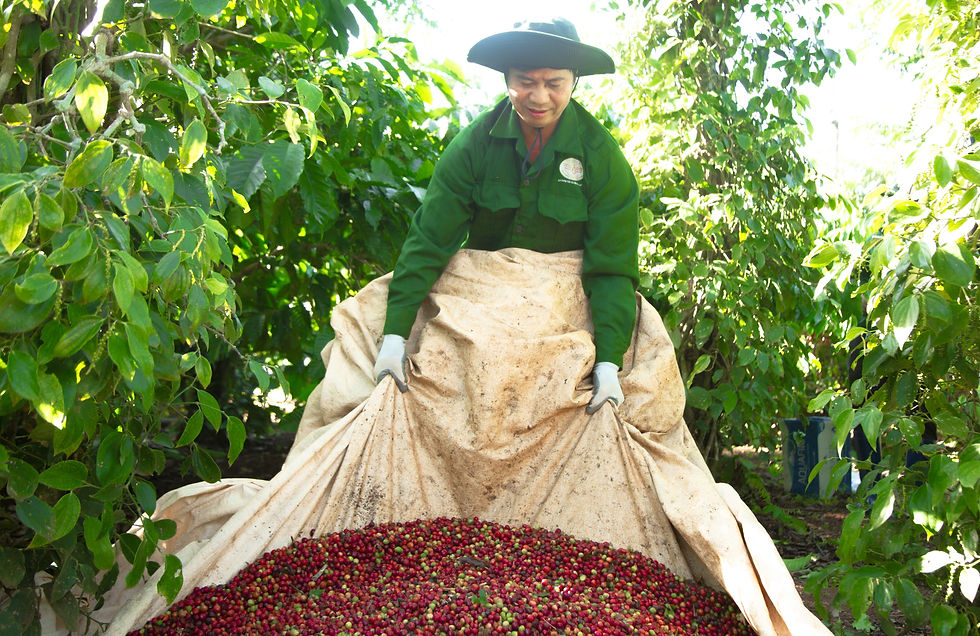
A defining feature of VTC’s approach is its community-based partnership model grounded in trust and shared responsibility. The company works directly with hundreds of farming households and multiple cooperatives in Đắk Lắk, committing to purchase coffee at prices above market levels while providing continuous technical support and organic knowledge transfer. To date, VTC has developed a linked production area of approximately 700 hectares, with dozens of hectares having fully transitioned to organic cultivation and hundreds of farming households actively practicing environmentally friendly production. These figures reflect not only the scale of production, but also the diffusion of a new production mindset—one in which economic returns are pursued alongside social and environmental responsibility.
The impacts of this model are evident across multiple dimensions. Environmentally, soil fertility has gradually been restored, water resources are better protected, and agricultural ecosystems have become more balanced and resilient. Economically, from the same hectare of organic coffee, farmers can generate value through multiple product streams, increasing economic returns by four to five times compared to conventional models, while reducing input costs by approximately 30 percent. Socially, more stable incomes, safer working conditions, and improved farmer health have contributed to stronger community cohesion through cooperatives and producer networks.
These positive outcomes are reinforced by tangible evidence. Several of VTC’s organic product lines have been successfully commercialized, the company has received consistent recognition from both domestic and international media, and it has been honored among the Top 50 outstanding local brands of Đắk Lắk Province. Together, these achievements demonstrate that organic coffee is not only environmentally and socially viable, but also commercially competitive-offering a compelling pathway toward a more responsible and resilient coffee economy.
More importantly, the model developed by Vuong Thanh Cong Organic Coffee (VTC) demonstrates strong potential for replication and adaptation in Vietnam as well as in other coffee-producing countries. By building on smallholder farmers, indigenous knowledge, and natural inputs, the model does not depend on large plantation-scale production, while significantly reducing risks for farmers during the transition period. Through free training programs, knowledge-sharing initiatives, and on-farm learning visits, VTC is gradually disseminating responsible production practices to a wider community, opening up opportunities for application across different crops and diverse local contexts.
From the perspective of responsible tourism, VTC’s story carries a profound message: responsibility does not begin at the destination, but at the very origin of products and the livelihoods of local communities.
When organic coffee is integrated with experiential activities, education, and cultural storytelling, the enterprise goes beyond producing goods for the market—it helps shape conscious consumption experiences that nurture deeper connections between people, nature, and communities.
In this context, coffee is no longer merely a beverage, but a symbol of a business model that respects ecological limits, places human values at its core, and aspires toward shared prosperity.
Conclusion
“Coffee Beans Sowing the Seeds of Happiness” is not a marketing slogan, but a development philosophy. The happiness of consumers stems from safe and trustworthy products; the happiness of farmers grows from sustainable livelihoods; and the happiness of the planet arises from respect for nature.
As the global economy moves toward green growth and responsible consumption, the Vuong Thanh Cong model demonstrates that organic agriculture is not only an ethical choice, but a strategic pathway for the future of Vietnamese coffee—one that aligns economic resilience with social well-being and environmental stewardship.

